Connect this guide with the rest of your visit in the Varanasi trip planner. Read how the research is made and what its sources establish.
At a glance
Start here
- Treat GI, handloom, fiber and construction as separate verifiable claims.
- Learn a few official brocade terms before comparing products.
- Check labels and registration numbers through the issuing official system.
- Ask for an itemized invoice that records the seller's material and production claims.
01
Separate the claims before comparing
The official GI registry records Banaras Brocades and Sarees as a registered geographical indication. A GI identifies a protected origin-linked product name; it is not a universal certificate for every textile sold in Varanasi. Ask how the exact piece connects to the registered product and whether the seller or producer appears in relevant official records.
Handloom is another claim, fiber is another, and construction is another. A textile can be discussed using several of these terms, but one does not automatically prove the rest. Write each claim on a separate line and ask for the supporting label, registration, specification or invoice wording rather than accepting a combined authenticity statement.
- Origin claim: check the GI registry.
- Handloom claim: check the relevant official mark.
- Fiber claim: request precise written composition.
- Construction claim: ask how the pattern is formed.
02
Learn the official brocade vocabulary
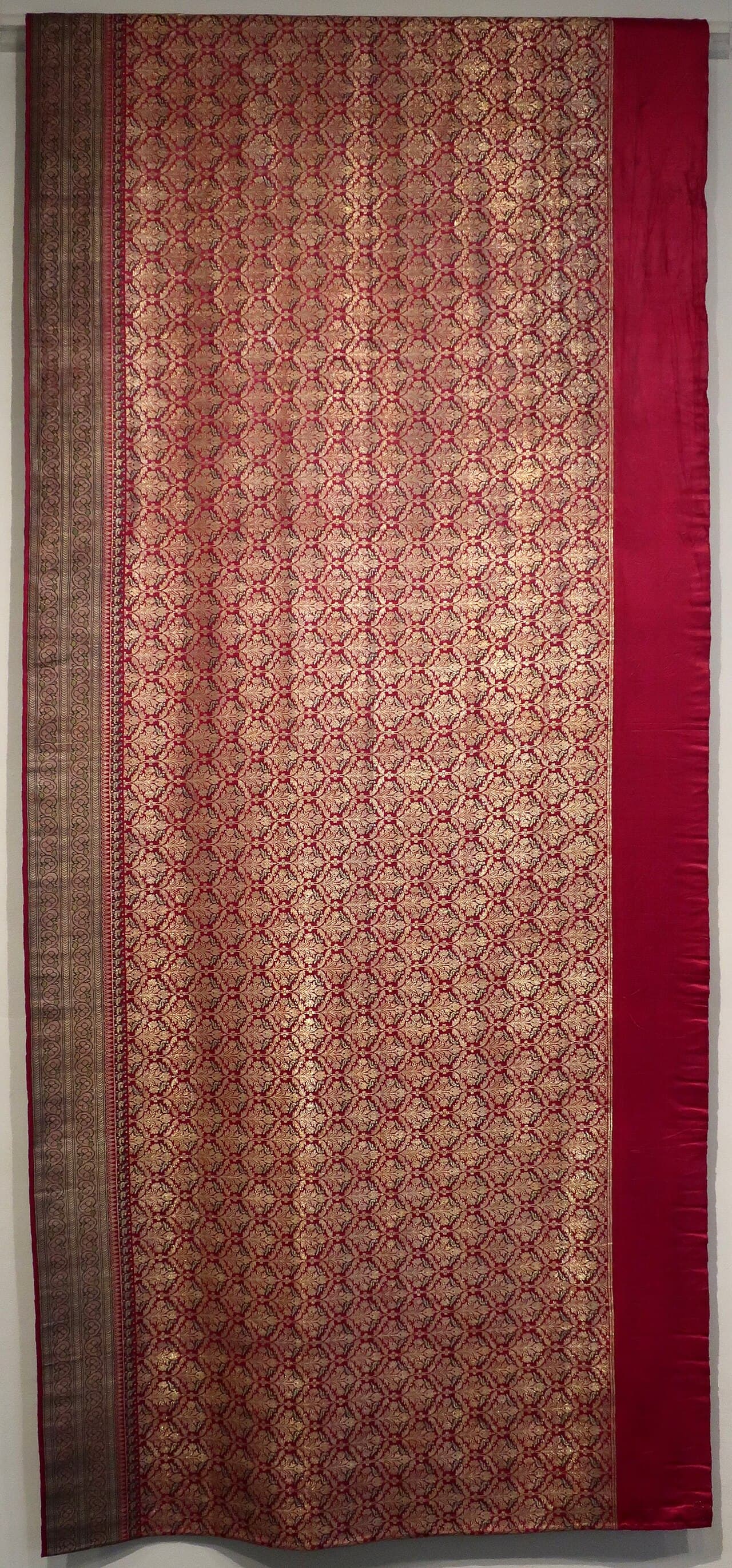
The Development Commissioner for Handlooms product profile explains brocade through extra patterning threads and describes established product families such as Jangla, Tanchoi, cutwork, tissue and butidar. These names are useful starting points, but they should lead to a construction explanation rather than operate as decorative sales labels.
Ask the seller to show where the patterning thread travels, how floats or cut ends appear, and which feature supports the named style. Compare two pieces side by side. The goal is not to become a textile examiner in an afternoon; it is to connect a spoken term to visible structure and documented product information.
- Ask which structure creates the motif.
- Compare the front and reverse where handling is permitted.
- Request the full product name in writing.
03
Verify labels through their issuing systems
The Development Commissioner for Handlooms describes the Handloom Mark as an authenticity system for handwoven products. India Handloom Brand adds stated quality and production parameters for registered products. These are related official programs, not interchangeable phrases, and a logo should be accompanied by the registration information required by the relevant system.
India Handloom Brand provides an authenticity-check page and a registered-user directory. Enter the supplied registration details in the official system rather than judging a printed logo alone. If the number does not resolve, ask the seller to explain and document the claim. Absence of one program does not by itself prove what a textile is; it simply limits that evidence.
- Identify which official scheme the label claims.
- Match the logo with its registration number.
- Use the issuing body's live verification tool.
04
Ask questions that produce comparable answers
Begin with material composition, weave or construction, place of production, producer or weaving unit, and the meaning of every label attached. Then ask how the named design category appears in the piece. A seller who uses a technical term should be able to point to the relevant feature without relying only on a burn test, slogan or dramatic demonstration.
Use the same questions in more than one shop or cooperative so the answers can be compared. Record exact wording rather than translating every response into good or bad. Differences may reflect product variation, but contradictions about the same piece deserve clarification before payment. No visual trick can replace documentation for a high-value claim.
- What is the written fiber composition?
- Where and by whom was it produced?
- Which label or registry supports each claim?
- What care instructions apply to this exact textile?
05
Make the invoice part of the product
Before payment, ask for an invoice that identifies the textile, seller, amount, material claim and any GI, handloom or India Handloom Brand details represented during the sale. Photograph the product beside its label and invoice number, keeping personal payment details out of any image shared publicly. Retain care information with the record.
If shipping is involved, record the seller's dispatch terms, package description and process for damage or mismatch before the item leaves. These are transaction terms, not facts this guide can promise. Pay through a method that produces a receipt, and do not allow verbal claims to become more specific after the invoice has been written.
- Match the invoice description to the exact item.
- Keep label, registration and care information together.
- Record shipping terms before dispatch.
06
Learn the process before entering a sales room
The Crafts Museum at Deendayal Hastkala Sankul presents handloom, tools, raw materials, techniques and GI products according to the district administration. A museum visit can establish process vocabulary without requiring an immediate purchase. It also puts silk and brocade beside other Varanasi craft traditions rather than isolating the sari from its wider making economy.
Use the visit to form questions, not to declare expertise. Note how a loom controls structure, how raw material differs from finished surface and how official GI names are written. Then carry that vocabulary into shopping. A demonstration arranged by a seller can be informative, but its commercial context should remain clear.
- Observe tools before judging finished surfaces.
- Copy official product names accurately.
- Keep museum learning separate from seller guarantees.
07
Use a calm final decision checklist
Pause before payment and restate what is known. The product name, construction, fiber, production claim, official labels, registration results, price, care and return or shipping terms should be distinguishable. If an important claim remains vague, either ask for written clarification or compare another piece. Urgency is not evidence.
Choose the textile whose documented qualities match the intended use and budget, not the one with the longest story. Some buyers prioritize a registered handloom product; others prioritize design, wearable weight or care. The responsible step is to know which choice is being made and which claims remain unverified.
- Can every premium claim be stated precisely?
- Does the invoice repeat the material description?
- Has each registration number been checked?
- Are care and transaction terms acceptable?
Useful answers
Reader questions
Does a Banarasi label prove a textile is GI registered?
No. Banaras Brocades and Sarees is a registered GI, but a product name or shop description alone does not establish the status of a particular item or seller. Check the official GI registry and ask for precise supporting documentation.
Sources: Geographical Indications Registry, Government of IndiaAre Handloom Mark and India Handloom Brand the same?
They are related but distinct official systems. The Handloom Mark identifies handwoven products, while India Handloom Brand describes additional quality and production parameters for registered products. Identify the claimed scheme and verify its registration through the appropriate official channel.
Sources: Development Commissioner for Handlooms, Government of India; Development Commissioner for Handlooms, Government of IndiaCan authenticity be judged from one visual test?
A single demonstration cannot establish origin, fiber, handloom status and construction at once. Ask separate questions, compare the piece with official product terminology, verify any registration number and require the seller's key claims in writing on the invoice.
Sources: Development Commissioner for Handlooms, Government of India; Geographical Indications Registry, Government of India; Development Commissioner for Handlooms, Government of IndiaWhere can visitors learn textile vocabulary before shopping?
The district describes the Crafts Museum at Deendayal Hastkala Sankul as presenting handloom, raw materials, tools, techniques and GI products. Bharat Kala Bhavan also holds textiles, but current gallery access should be checked separately before a visit.
Sources: District Varanasi, Government of Uttar PradeshRead the evidence
Sources and further reading
These sources support the relevant sections above. Plans and comparisons are editorial suggestions. Check operators for current arrangements.
- Details: Banaras Brocades and Sarees ↗Geographical Indications Registry, Government of India · Research date 14 September 2026
The official registration record and authorized-user framework for Banaras Brocades and Sarees.
- Banaras Brocades and Sarees: Product Profile ↗Development Commissioner for Handlooms, Government of India · Research date 14 September 2026
Official terminology for brocade construction and product families including Jangla, Tanchoi, cutwork, tissue and butidar.
- India Handloom Brand: Background ↗Development Commissioner for Handlooms, Government of India · Research date 14 September 2026
The distinction between Handloom Mark authenticity and India Handloom Brand quality and production parameters.
- Authenticity Check ↗Development Commissioner for Handlooms, Government of India · Research date 14 September 2026
Official verification of the India Handloom Brand logo and registration number.
- Deendayal Hastkala Sankul (Trade Facilitation Center & CraftsMuseum) ↗District Varanasi, Government of Uttar Pradesh · Research date 14 September 2026
Crafts Museum displays of handloom, materials, tools, processes and GI products.