Connect this guide with the rest of your visit in the Varanasi trip planner. Read how the research is made and what its sources establish.
At a glance
Start here
- Read the riverfront from water to steps, platform, building and lane.
- Look for patronage and rebuilding rather than assuming one construction period.
- Interpret architecture through use as well as facade and ornament.
- Describe the UNESCO Tentative List status accurately, without upgrading it.
01
Begin with the correct heritage status
UNESCO includes the Iconic Riverfront of the Historic City of Varanasi on India's Tentative List. A tentative listing is part of a country's process for sites it may consider nominating; it is not the same as inscription on the World Heritage List. Calling the riverfront a World Heritage Site would therefore be inaccurate.
The Tentative List description remains useful because it frames the riverfront as a relationship among ghats, temples, palaces, houses, lanes and continuing cultural practices. Read it as an official heritage argument, not as a final international designation. That encourages attention to both physical form and the living uses that shape it.
- Use the phrase UNESCO Tentative List.
- Do not call the riverfront World Heritage listed.
- Read the official statement as an interpretation framework.
02
Read a ghat as an urban section
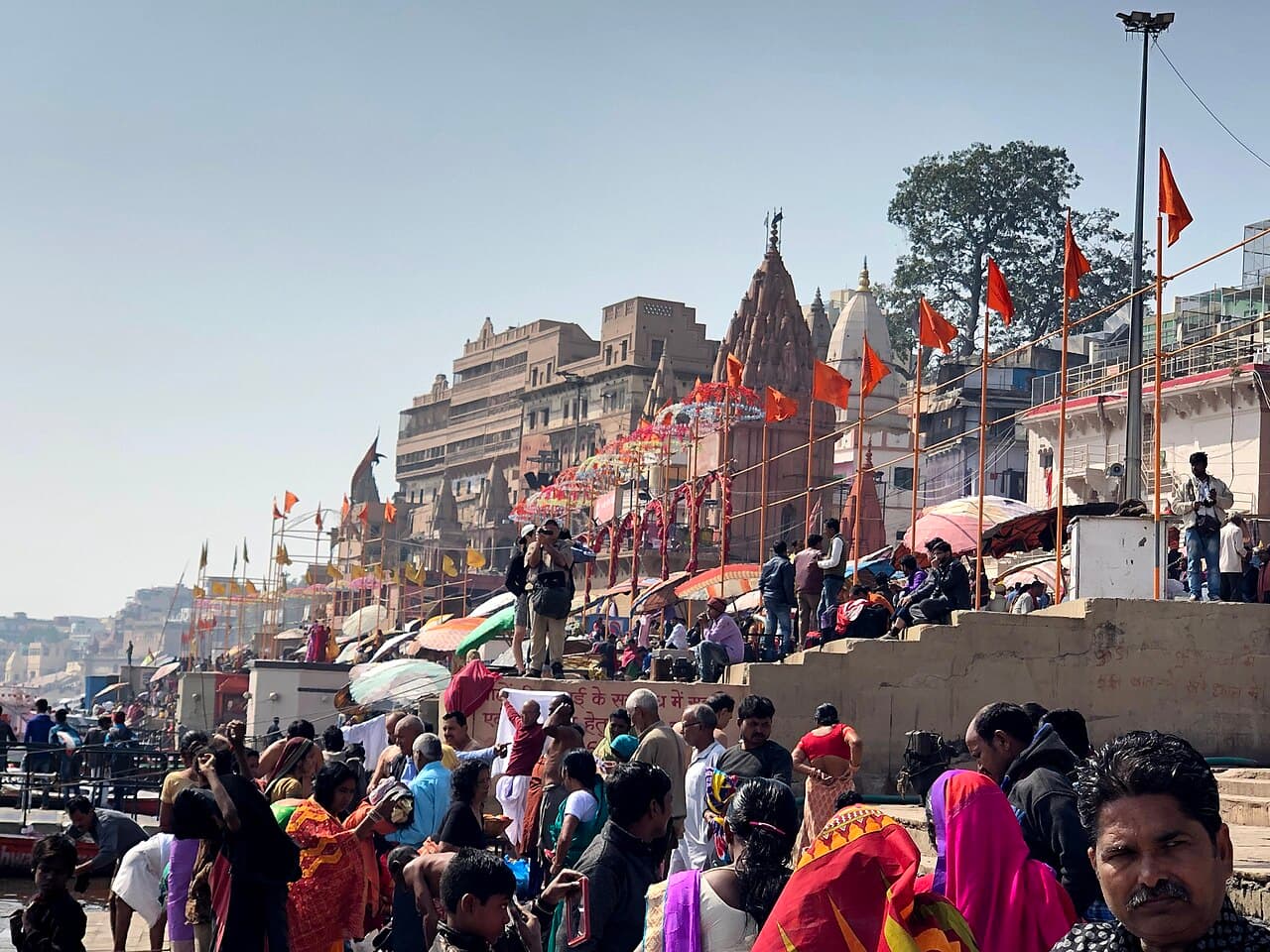
Start at the water and move backward with the eye. The first line is the changing river edge, followed by steps, landings or platforms. Behind those come retaining walls and building fronts; beyond them, lanes carry movement into the dense city. Each layer answers a different problem of access, gathering, elevation and connection.
Do not isolate the photogenic facade from the steps below or lanes behind. A tall building may announce patronage, but the platform can reveal how the edge is occupied. A lane opening can explain where people and goods enter. Sketching this sequence with five labels often produces a clearer reading than photographing ten facades without context.
- Label water, steps, platform, building and lane.
- Notice where levels change sharply.
- Track how movement enters and leaves the river edge.
03
Look for layers of patronage
The district administration notes that many ghats were rebuilt after 1700 and associates prominent building campaigns with rulers and patrons from different regions. UNESCO's description likewise presents a riverfront shaped across periods, including substantial Maratha-era patronage. The visible edge should not be assigned to a single ancient moment.
Ask who paid for a palace, temple, platform or rebuilding and what presence that patron created beside the river. Names can preserve those associations, but a name alone is not a construction date. Use plaques, official descriptions and architectural evidence together, and leave uncertainty visible when they do not align.
- Separate the age of a sacred place from the age of masonry.
- Treat ghat names as clues, not complete histories.
- Look for rebuilding and repair as part of the story.
04
Connect buildings, steps and lanes
The riverfront's architecture works through connections. Broad steps can narrow into landings; a palace wall can form a vertical backdrop; a temple may sit within a larger building line; and a lane can emerge through an opening that is easy to miss from a panoramic view. These joints show how the facade belongs to a deeper urban fabric.
Choose one short stretch and trace every route between water and lane without entering restricted spaces. Note where stairs turn, thresholds rise, walls retain earth and buildings bridge changes in level. The exercise reveals architecture as circulation and infrastructure, not only as surface style. It also explains why adjacent ghats can feel spatially different.
- Watch for stairs that turn behind the facade.
- Notice thresholds and retaining walls.
- Compare one open landing with one compressed passage.
05
Read function before decoration
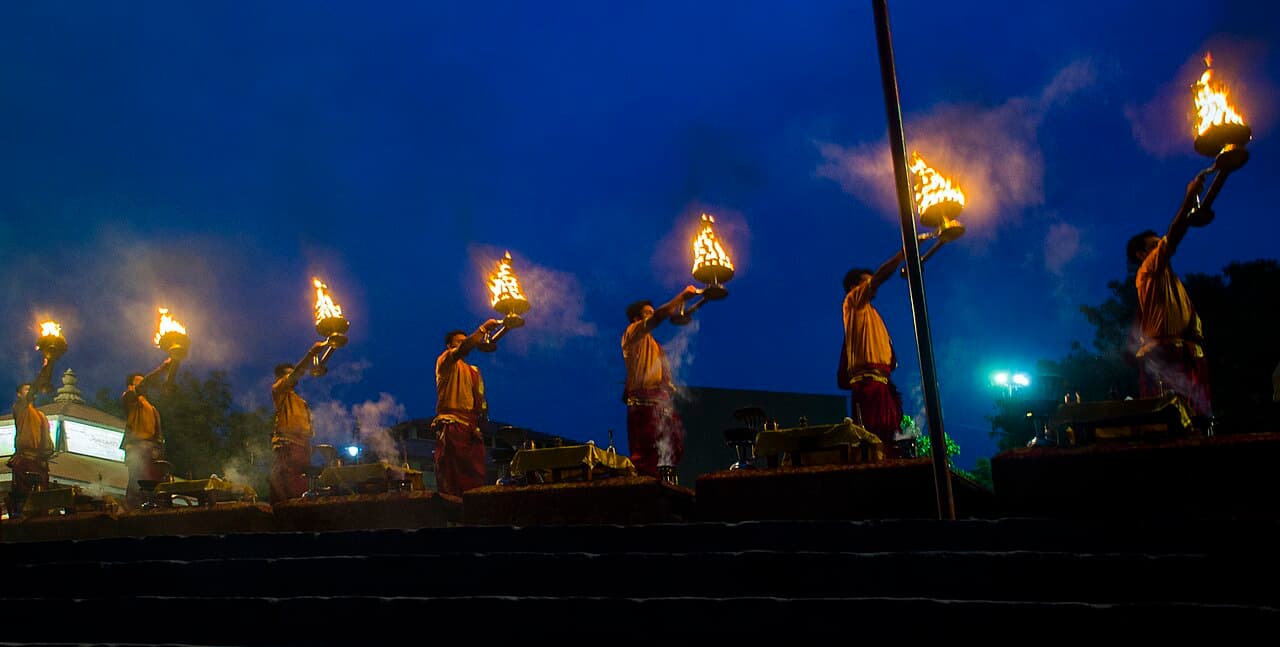
The district's ghat page groups riverfront spaces by uses that include bathing, worship and cremation. These categories are not merely labels on a map; they influence platforms, routes, boundaries and the kind of attention visitors should bring. An active religious or funerary space cannot be interpreted as an empty architectural stage.
Observe from an appropriate public position and prioritize the activity's dignity over the photograph. At cremation ghats, avoid intrusive observation and photography. Elsewhere, do not block routes or steps used for worship and work. These are practical implications of the official description of the ghats as living cultural spaces, not claims that every ghat functions identically.
- Identify the dominant use before framing a photograph.
- Keep working routes and worship spaces clear.
- Do not turn funerary activity into a spectacle.
06
Notice change without erasing continuity
Repair, replacement and adaptation are visible along a working river edge. Fresh stone beside worn steps, patched plaster, altered openings and new services do not automatically make the riverfront inauthentic. They can show how a demanding environment and continuing use require maintenance, though the meaning of any specific intervention needs evidence.
Compare materials, joints and weathering rather than guessing dates. Then ask what continues across the change: a route, a ritual focus, a building line or a relationship to the water. UNESCO's tentative-list account emphasizes the link between tangible fabric and living traditions, while the district's heritage page places architecture within a larger cultural system.
- Describe visible differences before assigning a date.
- Look for routes or uses that survive material change.
- Distinguish maintenance evidence from historical proof.
07
Use one repeatable observation framework
For each short riverfront segment, record six things: edge, step geometry, platform use, building type, lane connection and visible repair. Add one supported note about patronage or history only after checking an official source. This separates observation from interpretation and reduces the temptation to attach a dramatic story to every facade.
Repeat the exercise at a contrasting ghat. The comparison may reveal different proportions, access patterns or uses even where materials look similar. End by asking which relationship mattered most: water and step, platform and activity, building and patron, or lane and city. That answer is a more durable architectural memory than a ranked list.
- Record what is visible before researching the story.
- Compare two short sections using the same six fields.
- Keep uncertain dates or functions explicitly uncertain.
Useful answers
Reader questions
Is Varanasi's riverfront a UNESCO World Heritage Site?
No. UNESCO lists the Iconic Riverfront of the Historic City of Varanasi on India's Tentative List. That is not the same as inscription on the World Heritage List, so descriptions should preserve the distinction.
Sources: UNESCO World Heritage CentreWere all of Varanasi's ghats built in one period?
No. Official district and UNESCO descriptions present a layered riverfront, with many ghats rebuilt after 1700 and patronage associated with different periods and regions. The age of a sacred location should not be confused with the date of its present masonry.
Sources: District Varanasi, Government of Uttar Pradesh; UNESCO World Heritage CentreWhat should a visitor notice first at a ghat?
Start with the physical sequence from water to steps, platform, buildings and lanes. Then observe how people use those layers. This connects the visible facade to circulation, work and worship rather than treating the riverfront as a flat skyline.
Sources: UNESCO World Heritage Centre; District Varanasi, Government of Uttar PradeshIs photography appropriate at every ghat?
No. The district identifies different ghat functions, including worship and cremation, so the context matters. Avoid intrusive photography, especially around funerary activity, do not obstruct routes, and follow any posted or on-site restrictions.
Sources: District Varanasi, Government of Uttar Pradesh; District Varanasi, Government of Uttar PradeshRead the evidence
Sources and further reading
These sources support the relevant sections above. Plans and comparisons are editorial suggestions. Check operators for current arrangements.
- Iconic Riverfront of the Historic City of Varanasi ↗UNESCO World Heritage Centre · Research date 14 September 2026
Tentative List status and the official description of riverfront buildings, steps, lanes, patronage and living traditions.
- Ganga Ghat ↗District Varanasi, Government of Uttar Pradesh · Research date 14 September 2026
Ghat forms, categories, rebuilding after 1700 and patronage context.
- Culture & Heritage ↗District Varanasi, Government of Uttar Pradesh · Research date 14 September 2026
The relationship among the Ganga, architecture, archaeology, knowledge, music and craft in Varanasi's heritage.
- Temples Of Importance ↗District Varanasi, Government of Uttar Pradesh · Research date 14 September 2026
The continuing presence of active temples within Varanasi's urban and riverfront setting.